
How Much Should I Invest Per Month? A Simple Calculator by Income (2026)
How Much Should You Invest Per Month? (The Real Math)
How much to invest per month depends on your income, expenses, debt situation, and timeline. According to Vanguard and Fidelity, a commonly cited benchmark is 15–25% of gross income directed toward retirement and investment accounts. However, the most important factor is consistency — starting with any amount and increasing over time has historically produced better outcomes than waiting until a "perfect" amount is affordable. This guide breaks down what different monthly investment amounts produce over various time horizons.
TL;DR
A common target is 20–25% of gross income across all investment accounts (401(k), Roth IRA, taxable brokerage). If that's not feasible, start with whatever amount you can sustain consistently. $100/month invested at a 10% average annual return for 40 years grows to approximately $632,000. $300/month reaches roughly $1.9 million. $500/month reaches approximately $3.16 million. Increase contributions by 1% every 6 months or direct future raises to investing. The exact starting amount matters less than beginning early and scaling up over time. Automate contributions so they happen without manual effort.
The Framework
Start with whatever you can. $50/month, $100/month, $200/month — the specific amount is less important than establishing the habit. $50/month for 40 years at 10% average return grows to approximately $316,000. That's from a $24,000 total contribution. The rest is compound growth.
Target 20–25% of gross income as a long-term goal. At a $60,000 salary, 20% is $1,000/month across all investment and retirement accounts. This includes 401(k) contributions (including employer match), Roth IRA contributions, and any taxable brokerage investments. Most people don't start here, they build toward it. (Compare online brokerages)
Increase by 1% every 6 months. If you're contributing 5% of income now, bump it to 6% in six months, then 7%, then 8%. Gradual increases are absorbed more easily than large jumps. Over 3–4 years, you can double your savings rate without a dramatic lifestyle change.
Direct raises to investing. When income increases, allocate at least half of the raise to investments before adjusting lifestyle spending. If you receive a $3,000 annual raise, increasing monthly investments by $125 captures that growth while still allowing some lifestyle improvement. This is the most effective defense against lifestyle inflation.
Know the milestone that changes the math. The first $100,000 is the most difficult because your contributions do most of the work. After $100,000, compound growth begins contributing more than your deposits in many years. At $500,000+, your portfolio may generate more annual growth than your total annual contributions. The early years feel slow, that's normal and expected.
Comparison Table: What Different Monthly Amounts Become
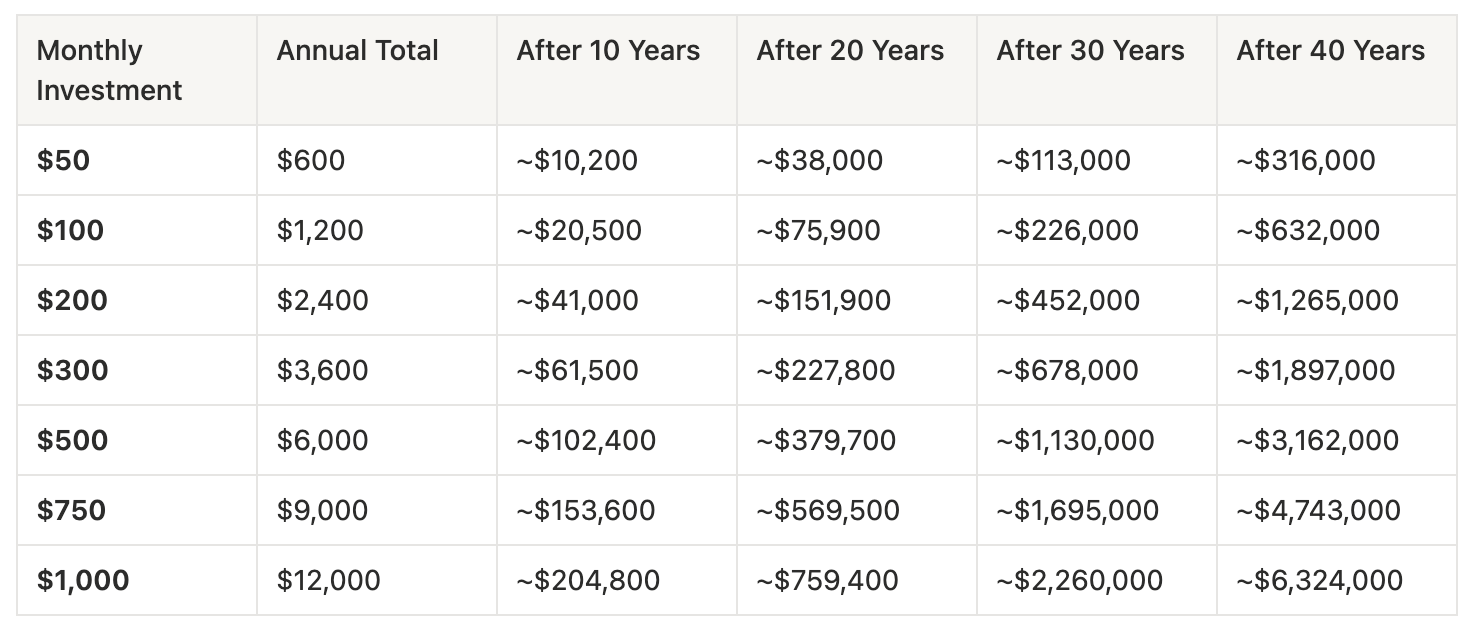
All figures assume 10% average annual return compounded monthly. Actual returns will vary. These are estimates for illustrative purposes.
Who is this for?
Anyone who is unsure whether their current investment amount is "enough"
Beginning investors trying to determine a reasonable starting point
People who want specific dollar projections to set monthly contribution targets
Households looking to increase savings rate without dramatically changing their lifestyle
Investors who want to understand the long-term impact of small, consistent contributions
FAQ
I only have $50/month to invest. Is that enough to matter?
$50/month for 40 years at 10% average annual return grows to approximately $316,000. Of that, only $24,000 is your own contributions, the rest is compound growth. As your income increases, so should your contributions. The habit of investing consistently is more valuable than the initial dollar amount.
Does the 20–25% target include my 401(k) contributions?
Yes. The total includes everything: your 401(k) employee deferral, any employer match, Roth IRA contributions, and taxable brokerage investments. If your 401(k) takes 10% of gross pay (including match) and your Roth IRA takes another 8%, you're at 18%, close to the target range.
Should I invest or pay off debt first?
For high-interest debt (credit cards at 18–25%), prioritize payoff, the effective return from eliminating that interest rate is difficult to match with market investments. (Explore debt relief options) For lower-interest debt (student loans at 4–7%), many investors choose to do both simultaneously: minimum payments on debt plus investing, especially to capture an employer 401(k) match. (Compare student loan refinance rates)
What if my income is inconsistent or freelance?
Set a minimum baseline you can sustain even in low-income months, even $50 or $100/month. In higher-income months, invest the excess. Many freelancers use a "pay yourself first" approach: when income arrives, immediately transfer 20% to investment accounts before allocating to expenses.
How do I invest more without feeling financially strained?
Automate contributions on payday so the money moves before you see it in your checking account. Most people adapt to the adjusted spending amount within 1–2 months. Additionally, directing raises and bonuses to investing (rather than lifestyle) allows you to increase contributions without reducing your current standard of living.
When should I start investing more aggressively?
After three conditions are met: (1) high-interest debt is eliminated, (2) you have at least a $1,000 emergency buffer (ideally building toward 3–6 months), and (3) you're capturing your full employer 401(k) match. Once those foundations are in place, increasing contributions toward 20–25% of income becomes the priority.
Related Guides
The Order of Investing: Where to Put Your Money First — Which accounts to fund first with your monthly investment amount
The $3 Million Retirement Math (Broken Down) — What consistent monthly investing produces over decades
Debt Payoff Strategy — When to prioritize debt payoff over investing
Sources
All content is for educational purposes only. Investing carries risk and past performance does not guarantee future results. This is not investing advice, specific recommendations, or legal advice. Consult a qualified professional for guidance specific to your situation. Some links in this article are affiliate links, meaning we may earn a commission at no extra cost to you if you click through and take action. We only recommend products and services we believe are genuinely useful.
